Feeding Rural Canada
Part Three of the Rural Solutions Series

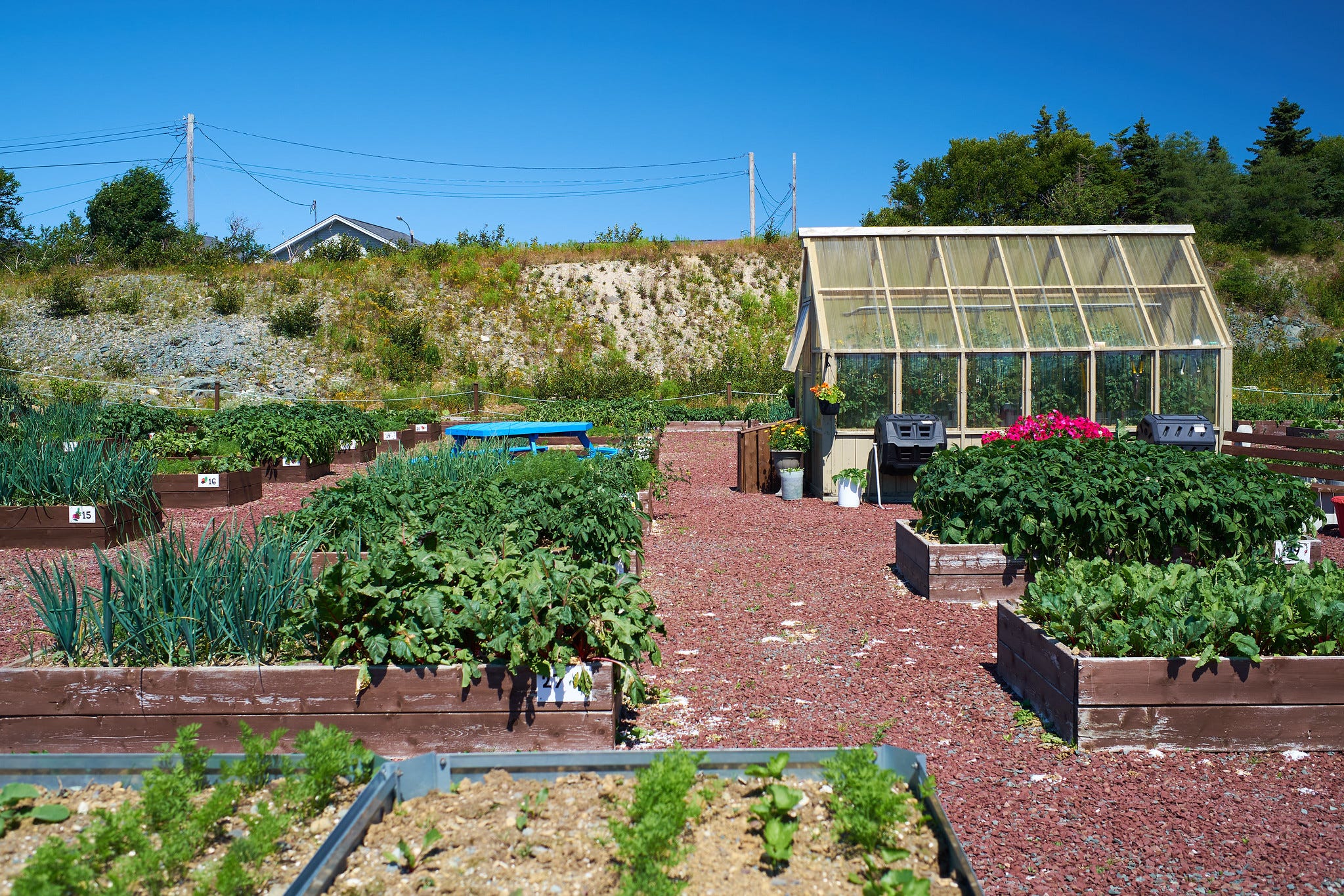
Above : The Whiteway community garden project, Whiteway Newfoundland
Loblaws
Empire
Metro
Wal-Mart
Costco
In Canada, the grocery business is dominated by this handful of companies. As with so much of Canadian industry, food has become a de facto oligopoly. Something like 2/3’s or more of every grocery dollar spent in Canada flows into just these five companies, two of which aren’t even Canadian.
In rural Canada, this situation is even worse. Many small towns and villages don’t even have a grocery store, or if they do, it’s a single store with an effective monopoly on the local market. In some cases, this is still a locally owned independent store, but increasingly, if such a store exists, it’s part of one of those large, dominant national chains.
Corporate concentration, profit maximization, and aging populations in many of these communities exacerbate these issues, leading to food deserts, high prices, and, often, poor quality. Aging populations also mean that traditional small local grocers that many have served these markets have been squeezed out or aged out.
Where I grew up, back in the 1980s, a town of less than 3,000 had, at one time, three grocery stores. A CO-OP store folded after intense price competition from one of the big chains, something never seen before or since. Today there exists a single grocery store, part of one the big chains.
The predatory behaviours of these large chains and their tactics to ensure local monopolies are even more apparent in rural Canada. It’s also well documented, for example, that the big chains engage in restrictive lease agreements that lock out potential competition in local geographic areas.
When we think of the business models of some of the above-mentioned companies, they don’t even serve rural areas except from a distance. Costco stores are typically located on the outer fringes of dense urban areas accessible essentially only by car. Most of Wal-Mart’s grocery business is through its Supercentres, again located mostly in urban areas not easily accessible without a car. For rural residents, this often requires hours of driving to reach one of these stores to ‘stock up’. Hardly something most people can do every day and not possible for those lacking access to private transport. It’s also worth noting that public transport from rural to urban areas is virtually nonexistent in much of rural Canada.
The other big grocery chains, when they do serve a rural location, do so through sub-brands focused on rural areas and are typically the only such store in the geographic region. They have an effective monopoly and often act as such. I noted a recent summer where a watermelon selling for $9 in rural Newfoundland could be had for $3 in a medium-sized Quebec city. I find it difficult to grasp a 3x price gap for a fruit grown and shipped to Canada from the southern United States. One difference worth noting is that the Quebec city has six large and two smaller grocery stores while the Newfoundland town has a single big chain store. It doesn’t take much imagination to understand a lack of competition is a major factor in such a whopping price difference.
So many rural areas are challenged by food insecurity, lack of competition, limited local food production, and lack of public transportation options.
Public Grocery Stores
This has come into the public conscience over the past couple of years. It basically involves grocery stores owned by the government or a community organization. These stores would focus on service and good prices, not maximizing profit for shareholders. One model would have these types of stores offering a limited selection of the most in-demand goods with a particular emphasis on fresh food while downplaying the usual middle aisles of the typical grocery store, which are packed with unhealthy, highly processed ‘convenience’ foods. These stores could also act as distribution points for community or local agricultural products, providing market access for local production and food warehousing, thus helping to fight food insecurity in rural communities. They could also act as community hubs for all manner of activities such as classes on cooking or growing food or as a meeting and organizing point for community gardeners and their networks. Another aspect not discussed is the possibility that such stores could assume the roles currently filled by food banks run by volunteers and small non-profits or at least provide a stable support for these organizations.
Public and Farmers Markets
In addition to publicly owned grocery stores, another key asset in the rural food security food chain is the farmers market. These serve multiple roles. They act not only as food stores but also as a direct farm-to-market route for growers, helping their financial viability by cutting out the middleman, which extract profit from the food chain, taking revenue from both farmers and consumers. Farmers’ markets also have agro-tourism potential, drawing visitors to sample regional agri-food products. This can support local food product developers/processors, providing them with a direct, nearby outlet for their products.
Supporting Infrastructure
All of the above only works if there is supporting infrastructure. Cold storage facilities and general warehouse space will be needed to support a robust distribution network. Such facilities will support local small-scale producers who don’t have access to storage and distribution. Collectively, this will strengthen the economic viability of local/regional food producers and processors.
Another possibility is the creation of food processing hubs with equipment and production facilities that could accommodate small-scale producers who need access to such facilities, allowing them to kickstart their businesses. There will also need to be transport available to move product through the distribution system. Again, this could be part of the public grocery concept or perhaps even an entity like Canada Post could find opportunity in this space. As for the grocery stores and markets, they will need facilities in which to operate, which could be sponsored by local or regional governments, thus making this a local grassroots undertaking whose decisions fit local needs.
Community Agriculture
Another underdeveloped resource is community agriculture. The most common form of this is the community garden, where residents grow produce on a common piece of land. When done correctly and with supportive infrastructure in place, these often modestly sized plots can be surprisingly productive. If these gardens could increase public participation, provide education/training for interested growers and tap into the public food system for storing/distributing their produce, they could provide a significant proportion of both fresh produce in season and over-wintering vegetables for rural communities. This is especially true in smaller towns and villages. There is also much potential for greenhouse production in this model, which is being developed to varying degrees across the country with room to expand within this concept.
Education and Training around Food/Processing/Cooking/Growing
One of the great untapped opportunities around public ownership of core components of the food system is in the areas of public health, education and economic development.
Current education systems have dropped the ball on teaching kids basic skills like cooking and healthy eating. This is obvious in any large chain grocery store. Take note of the percentage of the store’s footprint dedicated to highly processed ‘food’ products. I guarantee you it’s well above 50%. There are generations of people lacking food-related skills or a fundamental understanding of nutrition. Extending the role of local and community agriculture from producing fresh, healthy local food to actually teaching people how to make the best use of those newly cultivated resources has transformative potential . There is massive opportunity in creating community spaces / kitchens for such initiatives, perhaps even within public grocery stores.
In addition, there is the possibility of creating local food processing hubs that could provide training in food processing and food safety as well as facilities for entrepreneurs to test new product ideas. Such a public system could unlock entrepreneurial potential in rural areas that remains dormant due to lack of access to capital/training/facilities.
While pockets of such initiatives exist around the country, there hasn’t been a coordinated, well-resourced national strategy and plan for anything like this. This needs to change, and the possibilities are endless if the different levels of government could have a shared vision and desire to coordinate on these issues.
The Status Quo Comfort of the Usual Suspects
Now you have no doubt heard a lot of negativity from certain players around public grocery stores. This cackling has largely been driven by neoliberal/libertarian economic ideology, from entrenched players or people deeply embedded in the current system.
It doesn’t take much effort to see the consequences of the behaviour of the so-called free market. Big players have given themselves competition-excluding lease agreements for their store locations, fixed prices, aggressively undertaken industry consolidation, mislabeled products, and failed to serve many rural communities at all.
On top of that, it’s been known for years now that the revenue in the food system that flows to farmers is minimal compared with distributors and resellers.
It’s not for nothing that the big grocery chains keep posting massive profits. They keep trying to distract from this fact by saying it’s all down to higher volumes (well, duh) and to cosmetics/drugs from their pharmacy chains. This only highlights that they have also aggressively entered the pharmacy business in recent years, reducing competition in that space also, reinforcing oligopolies and anti-competitive behaviour, all with a passive shrug from the government.
This is market failure